Blog
Executive Presence vs Personal Branding: What Is The Difference, And Why Both Matter
Every few weeks, someone in a workshop asks me the same question in a different way. "Isn't personal branding just executive presence with a LinkedIn profile?" I understand why the two get mixed up. They both live in that space of how the world sees you. But in nearly three decades of working with leaders, from boardrooms to bidding tables to television studios, I have learned they are not the same thing. And confusing them is exactly why some very capable people stay invisible, while some far less capable people get remembered.
Let me explain the difference the simple way.
What Is Executive Presence
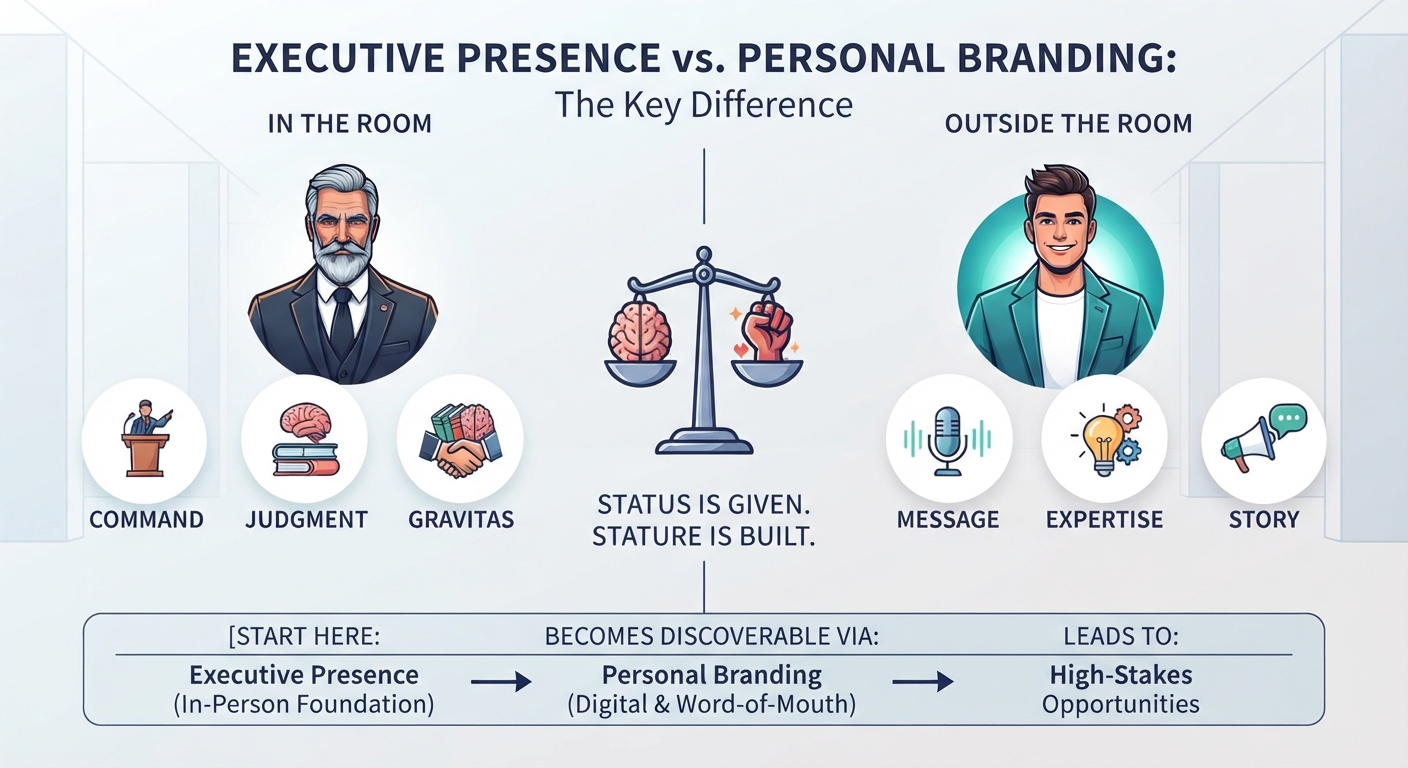
Executive presence is what happens in the room. It is how you carry yourself when you walk in, how you speak when you are put on the spot, how calm you look under pressure, and how much people trust your judgement before you have even finished your sentence. It is built through posture, voice, listening, timing, and the small, considered choices you make in real time.
Executive presence cannot be faked for long. People sense it within minutes of meeting you.
What Is Personal Branding
Personal branding is what happens outside the room, when you are not there. It is your reputation travelling ahead of you and staying behind after you leave. It lives in how you are described when your name comes up in a meeting you were not invited to, in your LinkedIn posts, your public talks, the interviews you give, and increasingly, in what shows up when someone types your name into a search engine or asks an AI assistant about you.
Personal branding is the story other people tell about you, when you are not in the room to tell it yourself.
Here is the part most people miss. You need both. Executive presence gets you remembered in the room. Personal branding gets you into rooms you were never physically present in.
A decade ago, personal branding was mostly for celebrities and CEOs of very large companies. For most professionals, your reputation was carried by word of mouth, your resume, and how you performed in the room. If you had strong executive presence, that was often enough. People remembered how you carried yourself in the meeting, and that memory travelled slowly, through conversations. Today, that memory travels instantly, and it travels without you. Search engines index everything you have ever posted publicly. Recruiters check your online presence before they check your resume. And now, increasingly, people are asking AI assistants questions like "who is a good executive coach in Mumbai" or "tell me about this person before I meet them," and the AI answers using whatever content exists about you online. If nothing exists, the AI simply cannot recommend you, no matter how strong you are in the room. This is the biggest shift I have seen in my career. Executive presence used to be sufficient on its own. Today, it needs personal branding to travel and to be discoverable, or it stays locked inside the rooms you are physically present in.
Real Life Examples
The Cricketer Who Had Presence But No Brand
Think of a domestic cricketer, technically brilliant, calm under pressure, respected by every teammate who has shared a dressing room with him. For years, his presence was undeniable in the room, on the field, in team meetings. But he never built a public voice. No interviews, no visibility, nothing for a sponsor or a franchise scout to find when they searched his name. Meanwhile, a less technically gifted player, who gave sharp interviews and stayed visible, ended up with the sponsorship deals and the captaincy conversations. Presence without a brand stayed invisible outside the dressing room.
The Actor Who Had Brand But No Presence
Contrast this with a young actor who built an enormous following through interviews, reels, and public appearances, all personality, all visibility. But when the actual audition or the actual set arrived, the presence did not match the online persona. Directors described him as inconsistent, uncertain, easily rattled under real pressure. His brand opened the door. His lack of presence meant he struggled to stay in the room once he was inside it.
The Corporate Leader Who Had Both
Now consider a mid level corporate executive I worked with, strong in every meeting, composed, clear, someone the room naturally deferred to. That was her executive presence. But for years, nobody outside her immediate team knew her name. We worked on her visibility, structured LinkedIn posts, a clear point of view in her industry, a handful of public talks. Within eighteen months, she was being invited to panels and headhunted for roles she would never have been considered for previously. The presence was always there. The brand is what made her discoverable.
Why You Cannot Choose Just One
If you only build executive presence, you stay excellent but invisible beyond your immediate circle. If you only build personal branding, you become visible but risk being exposed the moment you are actually in the room. The professionals who move fastest today build both, deliberately, together. That is the entire philosophy behind our PRESENCE Framework at The Stature Group. Status is given. Stature is built, one considered choice at a time, both in the room and outside it.
Frequently Asked Questions
Is executive presence the same as personal branding? No. Executive presence is how you come across in person, in real time. Personal branding is your reputation and visibility when you are not physically present, including what appears about you online and through AI search tools.
Can someone have personal branding without executive presence? Yes, and it is a common and risky combination. Strong visibility online without matching presence in person often leads to disappointment once someone actually meets you or works with you.
Why has personal branding become more important in recent years? Because search engines, recruiters, and now AI assistants all rely on your public digital footprint to form an opinion about you before you ever meet someone. If that footprint does not exist, you are simply left out of the conversation.
Which should a working professional focus on first, presence or branding? Executive presence should generally come first, because it is the foundation everything else rests on. Personal branding without genuine presence to back it up tends to collapse under scrutiny.
How can I start building both together? Start with the room you are already in. Sharpen how you communicate, carry yourself, and handle pressure in real meetings. Then build a simple, consistent public voice, through LinkedIn, talks, or interviews, that reflects that same person accurately.